The CHANNEL CODING PAGE

|
This page is dedicated to error-correcting codes and
their applications in digital communications and information theory. Thank
you for visiting this page. For any comment or information regarding this
page, please contact me at boutros at tamu dot edu. Last modification
made on Spring 2018. Joseph
Jean Boutros |
|

|
PERFORMANCE COMPARISON OF
SHORT-LENGTH ERROR-CORRECTING CODES |
|
|
We compare the performance
of short-length linear binary codes on the binary erasure channel and the
binary-input Gaussian channel. BCH, Reed-Muller, LDPC, and Polar codes are
considered. |
|
|
|
|
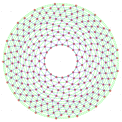
Circular Quadrature
Amplitude Modulations (CQAM) were discovered in a
recent work. The paper was published at the 2017 IEEE International Symposium
on Information Theory (ISIT) and can be downloaded
here. In this web page, we give
some extra properties of CQAM and extra nice drawings of CQAM constellations
we could not include in the conference paper at ISIT’2017. |

The content below dates back
to 2008, it is under renovation.
I will do my best to update asap. Joseph
|
|
|
|
This
is the 10th anniversary of GLD codes! GLD stands for Generalized Low Density. These codes
are Tanner structures with pseudo-random permutations. Under the impulse of
Gilles Zémor, I started to study those codes in
1997 with Olivier Pothier. The first document on
GLD codes dates back to January 1998. It has been submitted to ITW’1998. For
some reason, we have been told 4 months later that the organizers cannot
accept its publication due to the lack of space at the workshop…The work
appeared later at ICC’99 and VTC’99. More recently, we developped
full-diversity GLD codes for wireless channels with slow fading, i.e.,
quasi-static fading channels referred to as non-ergodic or block-fading channels. This
directory has been updated on January 12, 2008. |

|
Two simple exercises on point
lattices A2 and E8 I- Sphere Decoder II- Complex Construction for E8 |
|
|
Last
update on June 2006. |

|
For Graduate and Undergraduate
Students 3 Exams in Wireless Communications
Theory I- Fading in Wireless Channels. PS. PDF. II- Coding for Wireless Channels. PS. PDF. III- Multiuser Detection and Rake Receiver in CDMA. PS. PDF. |
|
|
Last
update on November 2008. |

|
AUTHORS |
TITLE |
My Comments |
Download Format and Size |
|
Robert G. Gallager |
Low-density
parity-check codes, MIT, 1963 |
Ph.D. report by Robert Gallager. LDPC codes first published by the author in
1962 are the ancestors of Turbo codes. |
|
|
Emanuele Viterbo & Ezio
Biglieri |
A universal
decoding algorithm for lattice codes, September 1993 |
Paper published at
GRETSI’1993 in Juan-Les-Pins, France. Emanuele was
the first to introduce the universal lattice decoder in the IEEE community. I
called it Sphere Decoder while we were developping
the C program in my software library in 1994. |
|
|
Joseph J. Boutros |
Lattice codes
for Rayleigh fading channels. Réseaux de points
pour les canaux à évanouissements, June 1996. |
Ph.D. report, ENST Paris, France. Directed by Jean-Claude Belfiore. The sphere decoding alorigthm
is in chapter 3, an introduction to algebraic number theory and rotated
modulations for fading channels. This was a direct extension of Boutros
thesis (mémoire de fin d’études
ENST) on algebraic construction of lattices in 1992. |
|
|
Emanuele Viterbo |
Analysis of
lattice constellations.Tecniche
matematiche computazionali per l’analisi ed il progetto di costellazioni a
reticolo, Februray 1995. |
Ph.D. report, Politecnico di Torino, Italy. Directed by Ezio Biglieri. Our joint work on rotated lattices from
algebraic number theory and rotated QAM modulations can be found in both PhD
reports. Emanuele’s report includes also the
Diamond cutting algorithm for Voronoi cells. |
|
|
Emanuele Viterbo & Joseph Boutros |
A universal
lattice code decoder for fading channels, June 1999 (submitted to the IT
Transactions in 1996!) |
The sphere decoder paper
for fading channels published in the IEEE Information Theory Transactions.
Nowadays, the sphere decoder is applied in MIMO, OFDM and CDMA systems. |
|
|
Loïc Brunel |
Channel decoding algorithms for code
division multiple access. Algorithmes de décodage
de canal pour l’accès multiple à étalement de spectre, December
1999. |
Ph.D. report, ENST Paris, France. Directed by Joseph
Boutros. You can find here how to do multiple access
without PN spreading (Turbo CDMA) and how to use the sphere decoder in CDMA.
The first part is a nice introduction to multiuser-detection in DS-CDMA (in french). Density evolution results on the performance of
some detectors are also included in this document. |
|
|
Olivier Pothier |
Compound codes
based on graphs and their iterative decoding. Codes composites construits à partir de graphes et leur décodage
itératif, January 2000. |
Ph.D. report, ENST Paris, France. Directed by Joseph
Boutros. You find here extensive details and results on Turbo codes, the
convergence of iterative APP decoding, Generalized Low Density codes
(GLD/Tanner) in both matrix and graph representations, and the design of interleavers for such codes on graphs. This Ph.D. document
is written in english. |
|
|
Catherine Lamy |
High spectral
efficiency communications over the Rayleigh fading channel. Communications à grande efficacité spectrale sur le
canal à évanouissements, April 2000. |
PhD report, ENST Paris, France. Directed by Joseph
Boutros. Plenty stuff on algebraic and non-algebraic multi-dimensional
rotations, Fast rotation transform (FRT), ML and DFE-MSE decoding of
lattices, bit-interleaved coded modulation (BICM) and EM channel estimation
for multiple antenna channels. You also find a capacity analysis of rotated
modulations on a fading channel. This document is written in french. |
|
|
Sandrine Vialle |
Construction and
analysis of new efficient channel coding structures for iterative decoding. Construction et analyse de nouvelles structures de
codage de canal adaptées au décodage itératif, December
2000. |
Ph.D. report, ENST Paris, France. Directed by Joseph
Boutros. You find in this document the performance limits of finite length
optimal codes under ML decoding, the definition and analysis of GLD (Tanner)
codes based on convolutional codes and extensive results on Density Evolution
thresholds for many channel coding families. This document is written in french. |
|
|
Céline Durand |
High spectral
efficiency modulations for non coherent
transmissions. Modulations à haute efficacité
spectrale pour les transmissions non cohérentes, December
2000. |
Ph.D. report, ENST Paris, France. Directed by Joseph
Boutros. You find correlated multi-dimensional FSK alphabets for non coherent detection. Trellis coded, lattice coded and
bit-interleaved coded modulations for non-coherent detection. An iterative non coherent APP detector is proposed. The report contains
a capacity analysis for orthogonal and non orthogonal
alphabets on a non coherent channel. This document is written in french. |
|
|
Hadi Sawaya |
Performance
optimization for capacity-approaching channel coding schemes, March 2002. |
Ph.D. report, ENST Paris, France. Directed by Joseph
Boutros. A nice asymptotic comparison between spherical codes and lattice
codes is given. You also find some results on turbo codes, especially
symbol-based (quaternary) APP decoding. Multilevel coded modulations (MLC)
are also studied as an efficient coding scheme for non
binary modulations. |
|
|
Sandrine Vialle & Joseph J. Boutros |
Performance of
optimal codes on Gaussian and Rayleigh fading channels: a geometrical
approach, October 1999. |
Paper presented at the 37th
Annual Allerton Conference, Illinois, USA. You can find in this paper how to compute the error
rate limits (best codes) given the coding rate and the finite code length. |
|
|
Joseph J. Boutros & Giuseppe Caire |
Iterative
multiuser joint decoding: Unified framework and asymptotic analysis, July
2002. |
Paper published in the
IEEE Transactions on Information Theory. This joint work with Giuseppe Caire unifies all techniques known as Turbo CDMA. Factor
graphs are used to represent the coded multiple access system and iterative
APP decoding is described as a sum-product algorithm. All interference
cancellation (IC) algorithms are derived in a unified way. Density Evolution
and Gaussian Approximation are used to determine the asymptotical CDMA system
limits. |
|
|
Loïc Brunel
& Joseph J. Boutros |
Lattice decoding
for joint detection in direct-sequence CDMA systems, April 2003. |
Paper published in the
IEEE Transactions on Information Theory, partly published at ITW’99 in South
Africa. It describes joint detection from a lattice point of view. The sphere
decoder is used to jointly decode up to 63 users. It is extremely important
to indicate that the sphere decoder is a maximum likelihood (ML) joint
detector when CDMA is synchronous. |
|
|
Joseph J. Boutros, & Nicolas Gresset |
HICCUP: Bit
interleaved coded modulation designed for multiple antenna channels with
iterative joint detection and decoding, July 2003. |
This report includes new
results on precoding via rotations for multiple
antenna channels, mapping optimization (both bidimensional
and multi-dimensional QAM/PSK mappings) for multiple antenna channels, and
soft output sphere decoding valid for all type of linear channels. |
|
|
Joseph J. Boutros, Nicolas Gresset & Loïc Brunel |
Turbo coding and
decoding for multiple antenna channels, September 2003. |
Paper published at the 3rd
International Symposium on Turbo Codes and Related Topics, Brest, France. The
paper mainly studies bit-interleaved coded modulation for multiple antenna
channels. Optimized binary QAM mappings, linear precoding
via cyclotomic rotations, and a space-time binary interleaver are proposed. The genie method described in
this paper simplifies some analytical computations under iterative APP
detection/decoding of the space-time BICM. |
|
|
Joseph J. Boutros, Nicolas Gresset, Loïc Brunel & Marc Fossorier |
Soft-input
soft-output lattice sphere decoder for linear channels, December 2003. |
Paper published at
Globecom’2003, San Francisco. We propose a soft-output sphere decoder based
on both Pohst and Schnorr-Euchner
strategies. Illustration is made via bit-interleaved coded modulation (BICM)
for multiple-antenna channels (MIMO). The soft-output (list processing)
sphere decoder is outside the detection/decoding loop. |
|
|
Albert Guillén i Fàbregas |
Concatenated
codes for block-fading channels, June 2004. |
PhD thesis, EPFL,
Lausanne, Switzerland. Supervised by Giuseppe Caire.
Defended in front of the following jury: Joseph J. Boutros, Giuseppe Caire, Raymond Knopp, Giorgio Taricco, Emre Telatar, and Rüdiger Urbanke. |
|
|
Nicolas Gresset |
New space-time
coding techniques with bit interleaved coded modulations, December 2004. |
PhD thesis, ENST, Paris,
France. Supervised by Loïc Brunel and Joseph J.
Boutros. Defended in front of the following jury: Geneviève Baudoin, Jean-Claude Belfiore, Loïc Brunel, Raymond Knopp,
Hans-Andrea Loeliger, Hikmet
Sari, and Gilles Zémor. |
|
|
Various authors from North-America, Europe,
and other continents. |
Turbo Coding
versus LDPC Coding. Updated on November 7, 2006. |
I did this selection last
year with my students. They used those papers in their project on Advanced
Digital Communications and Coding (ADC course). I may update the list of
selected papers in the coming weeks. I limited my fine selection to 11 papers
on LDPC codes and 12 papers on Turbo codes. The degree of difficulty varies
from simple to very difficult. |
|
|
Fatma Kharrat-Kammoun |
Adaptive
techniques and classifications for MIMO systems, October 2006. |
PhD thesis, ENST, Paris,
France. Supervised by Sandrine Fontenelle, Hugues
Randriambololona, and Joseph J. Boutros. Defended
in front of the following jury: Ezio Biglieri, Raymond Knopp, Emre Telatar, Jean-Claude Belfiore, Hugues Randriambololona, Stéphanie Rouquette, and myself. |
|
|
Ghassan Kraidy |
Coded
modulations for the multiple-antenna and cooperative fading channels, July 2007. |
PhD thesis, ENST, Paris,
France. Supervised by Joseph J. Boutros. Defended in front of the following
jury: Inbar Fijalkow,
Helmut Bölcskei, Raymond Knopp,
Philippe Godlewski, Dirk Slock,
Nicolas Gresset, and myself. |
![Description: [ ]](channel_coding_page_files/image018.gif)
![Description: [ ]](channel_coding_page_files/image020.gif)
![Description: [ ]](channel_coding_page_files/image022.gif)
![Description: [ ]](channel_coding_page_files/image024.gif)
![Description: [ ]](channel_coding_page_files/image026.gif)
![Description: [ ]](channel_coding_page_files/image028.gif)
![Description: [ ]](channel_coding_page_files/image030.gif)
![Description: [ ]](channel_coding_page_files/image032.gif)
![Description: [ ]](channel_coding_page_files/image034.gif)
![Description: [ ]](channel_coding_page_files/image036.gif)

![Description: [ ]](channel_coding_page_files/image040.gif)
![Description: [ ]](channel_coding_page_files/image042.gif)
![Description: [ ]](channel_coding_page_files/image044.gif)
![Description: [ ]](channel_coding_page_files/image046.gif)
![Description: [ ]](channel_coding_page_files/image048.gif)
![Description: [ ]](channel_coding_page_files/image050.gif)
![Description: [ ]](channel_coding_page_files/image052.gif)


![Description: [ ]](channel_coding_page_files/image058.gif)
![Description: [ ]](channel_coding_page_files/image060.gif)
![Description: [ ]](channel_coding_page_files/image062.gif)


![Description: [ ]](channel_coding_page_files/image070.gif)
![Description: [ ]](channel_coding_page_files/image072.gif)
![Description: [ ]](channel_coding_page_files/image074.gif)
![Description: [ ]](channel_coding_page_files/image076.gif)
![Description: [ ]](channel_coding_page_files/image078.gif)
![Description: [ ]](channel_coding_page_files/image080.gif)


|
Spherical Codes on the Gaussian
Channel Performance of optimal codes at
finite length |
|
|
Last
update on November 2006. |

|
A tutorial introduction to
space-time coding |
|
|
Presented at the Conference on Coding and Cryptography Carcans,
France, March 2008. |
|
|
|

|
A tutorial on iterative
probabilistic decoding and channel estimation |
|
|
Presented at the IAP MOTION plenary meeting, Ghent University,
Belgium, January 13, 2005. Download paper in Postscript Format or in Portable Document Format |
|
|
Recent talk related to this tutorial Introductory talk on Iterative
Processing of Information Beirut, Lebanon, April 2006 |

|
Accurate Approximation of QAM
Error Probability on Quasi-static MIMO Channels and its Application to Adaptive
Modulation |
|
|
Paper submitted to the IEEE Transactions on Information Theory, November 2004, revised on March 2006. Download paper in Postscript Format or in Portable Document
Format |

|
|
|
|
Database and computer simulation |

|
|
|
|
libcom.a archive and C programs compiled under RedHat 9, Linux
kernel 2.4.20 and Solaris 5.8 |